
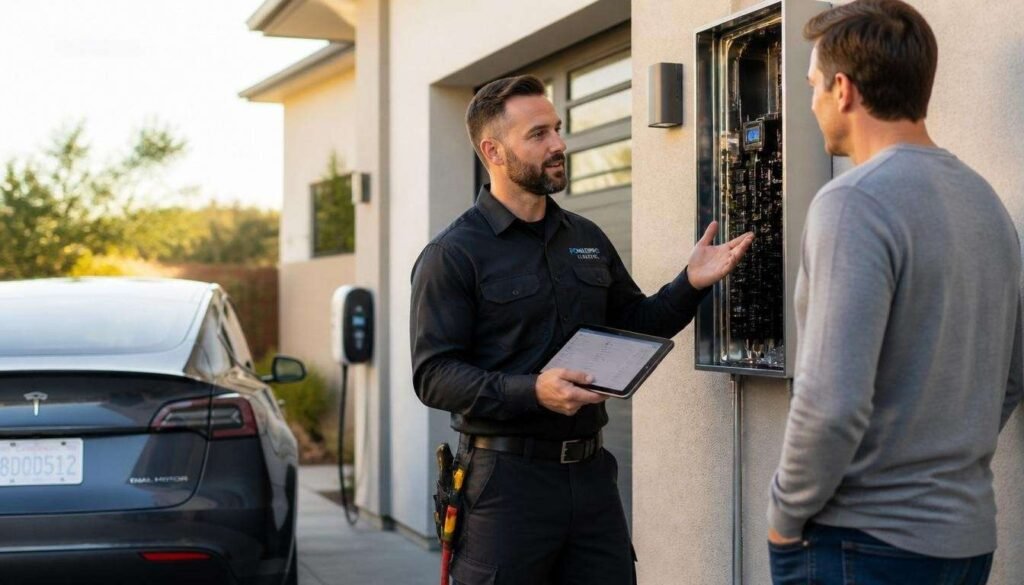
The way homeowners find electricians has shifted faster in the last two years than in the previous decade. AI search tools, voice assistants, and automated marketing platforms have changed the entire lead generation game. If you are still relying on the same channels you used in 2023, you are leaving real jobs on the table.
This guide breaks down exactly what is working right now, what it costs, and how to build a system that keeps your schedule full without chasing bad leads.
Why 2026 Is a Turning Point for Electrician Lead Generation
The electrical trade is sitting at the center of three massive demand drivers at once. That is both an opportunity and a challenge. More demand means more competition for the same homeowners, which means your marketing has to work harder and smarter than before.
The Demand Explosion: EV Chargers, Panel Upgrades, and Smart Home Installs
Homeowners are adding EV chargers, heat pumps, battery storage systems, and smart panels to homes that were never wired to handle that load. According to the U.S. Bureau of Labor Statistics, electrician jobs are projected to grow 9% through 2034, with roughly 81,000 openings per year. That demand is real and it is happening right now in your service area.
Panel upgrades, EV charger installations, and whole-home generator hookups are the highest-margin jobs in the residential electrical space today. These are also the services homeowners search for most actively, which makes them the best target for your lead generation focus in 2026.
How AI Search Has Changed the Way Homeowners Find and Choose Electricians
A homeowner today does not always open Google and type “electrician near me.” Many of them open ChatGPT or Perplexity and ask a full question like “Do I need a panel upgrade before installing an EV charger?” The AI pulls an answer, and increasingly, it names a specific electrician to call.
This shift means that showing up in AI-generated answers is now just as important as ranking on Google Maps. Electricians who are not optimizing for AI search visibility are already being passed over, even when they rank well in traditional search results.
Why Shared Lead Platforms Are Losing Ground to Owned Lead Systems
Platforms like Angi and HomeAdvisor sell the same lead to three or four electricians at once. You pay $25 to $100 per lead and then race to be the first to call. Even when you win the job, your cost per acquired customer ends up being far higher than the lead price suggests.
Smart electricians in 2026 are building their own lead systems through local SEO, AI search optimization, and automated follow-up. These systems take longer to build but they produce exclusive leads you do not share with anyone.
The Real Numbers: Electrician Lead Gen Costs and Benchmarks
Before you spend a dollar on marketing, you need to know what leads actually cost and which services make that spend worthwhile. The numbers in this space vary widely, and most electricians are working with outdated assumptions.
Average Cost Per Lead Across Paid Platforms vs. Organic Channels
Buying leads from broker platforms runs $25 to $100 per lead, but because those leads are shared, your real cost per booked job is significantly higher. Google Ads clicks in competitive electrical markets run $30 to $80 per click depending on your location and the service you are targeting.
Organic leads through local SEO cost far less per lead once your system is built. The tradeoff is time. You are typically looking at three to six months before organic channels produce consistent volume, but the cost per lead drops steadily from there.
What Electricians Are Actually Spending on Marketing Per Month
A growing electrical company with two or three trucks typically spends between $1,500 and $3,500 per month on lead generation. That covers a combination of Google Ads, local SEO maintenance, and review management.
Electricians who have built strong organic and AI search visibility spend less over time because they are not paying for every click. The goal is to shift your budget from renting leads to owning the channels that produce them.
Which Electrical Services Deliver the Highest Lead-to-Revenue ROI
Not all leads are equal. Emergency panel calls, EV charger installations, whole-home generator hookups, and electrical service upgrades carry the highest average job values. These are the services worth targeting with paid campaigns because the margin justifies the cost per lead.
General service calls and outlet repairs have lower margins and attract more price-sensitive customers. You can still rank for those terms, but your ad spend is better directed toward high-ticket services that move the revenue needle.
The Hidden Cost of Competing for Shared Leads
When you buy a shared lead, you are not just paying the platform fee. You are paying with your time every time you call and lose to a competitor who answered faster. Research from Invoca shows that contractors who respond within five minutes are 100 times more likely to qualify a lead than those who wait 30 minutes or more.
Shared leads punish slow responders and reward whoever calls first. That is a race you can opt out of entirely by generating your own exclusive leads through channels you control.
The AI Lead Generation Stack Every Electrician Needs
You do not need ten different tools. You need a focused stack that covers three things: capturing leads the moment they come in, following up automatically, and identifying homeowners before they even search. Here is what that looks like in practice.
AI Voice Receptionists: Stop Losing Emergency Calls to Voicemail
A homeowner who smells burning from an outlet at 9 PM is not going to leave a voicemail and wait until morning. If you do not answer, they call the next electrician on the list. AI voice receptionists like Jobber’s AI Receptionist or tools like AgentVoice answer inbound calls, collect job details, and book appointments without any human involvement.
This single tool can recover a significant number of after-hours leads that currently go to competitors simply because no one picked up.
AI Chatbots for Electrician Websites: Capture and Pre-Qualify Leads 24/7
An AI chatbot on your website does more than answer questions. It pre-qualifies the lead by asking what service the homeowner needs, when they are available, and what their location is. By the time you see the inquiry in the morning, it is already sorted and ready to act on.
Businesses using AI chatbots report a 30 to 50 percent increase in lead conversion rates compared to standard contact forms. For electricians who get traffic outside business hours, that improvement compounds fast. To learn more about how your website should be set up to support this kind of conversion, read our guide on how your electrician website should be built.
AI-Powered CRM and Automated Follow-Up: From Inquiry to Booked Job
Most leads do not book on the first contact. An AI-powered CRM sends follow-up texts and emails automatically based on where the lead is in the process. If someone requests a quote and does not respond, the system follows up at 24 hours, 48 hours, and again at seven days without you having to remember to do it manually.
Platforms like ServiceTitan, Housecall Pro, and QuoteIQ all include some level of AI follow-up automation. The key is making sure your CRM is configured to trigger these sequences the moment a new lead comes in.
Predictive Lead Scoring: Reaching Homeowners Before They Search
Tools like PropertyRadar use AI to analyze over 250 property data points and identify homeowners most likely to need electrical work. For electricians, that means targeting homes with aging panels, recent permit activity, or property characteristics that signal EV charger or service upgrade demand.
This is proactive marketing rather than reactive marketing. Instead of waiting for a homeowner to search, you are putting your business in front of them at exactly the right moment.
Getting Found on ChatGPT, Perplexity, and Google AI Overviews
This is the section most electricians are not paying attention to yet, which makes it the biggest opportunity available right now.
What Generative Engine Optimization Means for Local Electricians
Generative Engine Optimization, or GEO, is the practice of structuring your online presence so that AI answer engines cite and recommend your business. It is different from traditional SEO because AI engines weight structured data, content clarity, and citation signals more heavily than raw backlink counts.
An electrician in a mid-sized market with strong GEO signals can appear in ChatGPT and Google AI Overview results faster than a competitor with years of traditional SEO behind them. Check out our breakdown of how to rank higher on Google Business Profile as an electrician to understand the foundational signals that feed both traditional and AI search.
Schema Markup That Gets Your Business Cited by AI Answer Engines
Schema markup tells AI engines exactly what your business does. For electricians, the most important schema types are LocalBusiness, Service, FAQPage, HowTo, and Review. Without these, AI engines have to guess at what you offer, and guessing means you get passed over for competitors with cleaner data.
Every service page on your website should have Service schema that names the specific offering, the service area, and the price range where possible. This is one of the fastest technical wins available for electricians who want AI search visibility.
How to Write Content AI Engines Extract, Trust, and Recommend
AI engines prefer content that answers questions directly and specifically. That means short declarative paragraphs, clear subject-verb-object sentences, and FAQ sections that match exactly how homeowners phrase their questions in conversational search.
A page that clearly answers “How much does a 200-amp panel upgrade cost in Sheridan” with a specific range, an explanation of variables, and a call to action gives AI engines exactly what they need to surface your business as the answer. Generic content that dances around the question gets skipped entirely.
Reviews, GBP Consistency, and NAP Signals: The AI Ranking Trinity
AI engines cross-reference your Google Business Profile, your website, and third-party directories to verify that your business is legitimate and consistent. If your name, address, and phone number do not match across those sources, AI engines lose confidence in recommending you.
A steady flow of recent reviews on Google is also a direct signal. AI engines treat review velocity as a trust indicator. Electricians with 50 reviews from the last six months consistently outperform those with 200 older reviews and no recent activity. For a practical approach to building reviews through your GBP, see our post on using Google Business Profile posts to engage your customers.
Local SEO for Electricians: What Still Works in 2026
Local SEO has not become irrelevant. It has become the foundation that feeds everything else, including AI search visibility.
Google Business Profile Optimization That Drives Calls, Not Just Views
Your Google Business Profile is the single most important local SEO asset you have. A fully optimized profile with accurate service categories, high-quality photos, a detailed business description, and weekly posts generates more direct calls than almost any other organic channel.
The electricians ranking at the top of Google Maps in 2026 are posting updates consistently, responding to every review, and keeping their service list current with high-demand offerings like EV charger installation and panel upgrades. For a deeper look at what ranking higher on Local Service Ads requires, read our guide on how to rank higher on Local Service Ads as an electrician.
Location Pages and Service-Area Content That Convert Visitors to Leads
A single “service areas” page does not cut it anymore. Each city or neighborhood you serve should have its own page with specific content about local electrical needs, permit requirements, and job examples from that area.
These pages give both Google and AI engines the geographic specificity they need to recommend you for local searches. They also convert better because homeowners see content that feels written for their community rather than a generic service description.
Why Local SEO Now Feeds AI Citations as Much as Google Rankings
The same content signals that help you rank in Google Maps are the signals AI engines pull from to build their answers. A well-optimized website with location-specific pages, consistent GBP data, and strong review signals does not just rank in traditional search. It gets cited in AI Overviews, ChatGPT responses, and Perplexity answers at the same time.
This convergence means that investing in local SEO in 2026 gives you returns across multiple search surfaces simultaneously.
Paid Advertising for Electricians: AI-Enhanced Campaigns That Convert
Paid advertising is still one of the fastest ways to fill your schedule when you need jobs now. The difference in 2026 is that AI-enhanced campaigns perform significantly better than manually managed ones.
Google Local Services Ads and the Google Guaranteed Badge
Google Local Services Ads place your business at the very top of search results above traditional paid ads and organic listings. The Google Guaranteed badge that comes with LSA verification builds immediate trust with homeowners who do not know your company yet.
You pay per lead rather than per click with LSAs, which makes budgeting more predictable. For electricians in competitive markets, LSAs are consistently one of the best-performing paid channels available right now.
Smart Bidding Strategies for High-Intent Electrical Keywords
Google’s AI-driven Smart Bidding adjusts your bids in real time based on the likelihood that a specific search will convert. For electricians, this means your ads show more aggressively for someone searching “emergency electrician near me at night” and less aggressively for lower-intent browsing searches.
Pairing Smart Bidding with tightly focused ad groups built around high-margin services like panel upgrades and EV charger installs gives you the best cost-per-acquisition results. You can also use A/B testing on your electrician ad campaigns to find which ad copy variations bring in the most qualified calls.
Running Profitable Meta Ads for Panel Upgrades, EV Charger Installs, and Solar
Facebook and Instagram ads work best for electricians when you target specific high-ticket services rather than general electrical work. Homeowners who recently purchased an EV, live in an older home, or have shown interest in solar are all targetable through Meta’s audience tools.
Video content showing a completed EV charger install or a before-and-after panel upgrade performs especially well on social. These posts build credibility while generating direct inquiries from homeowners who are already thinking about the service.
AI-Powered Content Marketing: The Long Game That Fills Your Calendar
Content marketing does not produce leads overnight. But electricians who committed to it 12 months ago are now generating consistent organic traffic and AI citations at a fraction of what paid ads cost.
Turning Real Job Experiences Into Local SEO Content With AI
You do not need to be a writer to produce good content. Record a two-minute voice memo after an interesting job, describe what you found, what you fixed, and what the homeowner should watch for. Use an AI writing tool to turn that memo into a 600-word blog post that answers a real question local homeowners are searching for.
This approach produces content with genuine local specificity and real job knowledge, which is exactly what Google and AI engines reward. Generic AI-generated content without that local context does not rank. Content built on your actual experience does.
Seasonal and Trigger-Based Content That Captures Demand at Peak Moments
Electrical demand spikes follow predictable patterns. Summer heat waves drive searches for “breaker keeps tripping AC unit.” EV tax credit announcements drive searches for “EV charger installation cost.” Storm season drives searches for “whole home generator installation near me.”
Publishing content ahead of these windows puts you in front of homeowners at the exact moment they are ready to book. Our guide on adapting your electrician business to seasonal trends gives you a practical framework for planning this content calendar.
How Blog Posts and FAQs Feed Both Google Rankings and AI Citations
Every FAQ you publish on your website is a potential AI citation. When a homeowner asks ChatGPT “how long does a panel upgrade take,” the AI pulls from pages that answer that question clearly and directly. If your site has that content and your competitor does not, you get the citation and the call.
Blog posts that address specific service questions, cost ranges, and local permit requirements give AI engines a steady stream of accurate, citable content to work with.
Email and SMS Campaigns That Turn One-Time Customers Into Repeat Business
A homeowner who hired you for an EV charger install is a strong candidate for a panel upgrade, a whole-home surge protector, or outdoor lighting. AI-powered email and SMS tools send the right follow-up at the right time based on what service they previously booked.
These campaigns cost almost nothing to run once they are set up and consistently produce repeat jobs from customers who already trust you.
Lead Conversion: Turning More Inquiries Into Booked Electrical Jobs
Getting leads is only half the job. Converting them is where most electricians lose money without realizing it.
Why Response Speed Is the Biggest Conversion Variable for Electricians
Contractors who respond within five minutes are 100 times more likely to qualify a lead than those who wait 30 minutes or more. For emergency electrical calls, that gap is even more severe. The homeowner calls three electricians in a row and books the first one who answers.
AI voice tools and chatbots solve this problem completely. They respond instantly, collect the job details, and either book the appointment or flag it for your immediate callback. Speed wins jobs.
Booking Automation and Follow-Up Sequences That Close More Leads
Most leads do not convert on the first touchpoint. A homeowner who requests a quote for a panel upgrade might need two or three follow-ups before they commit. Manual follow-up is inconsistent and time-consuming. Automated sequences handle it without any effort on your end.
Set up a simple sequence: immediate confirmation text, follow-up at 24 hours if no response, a second follow-up at 72 hours with a specific offer or urgency prompt. This alone recovers a meaningful percentage of leads that would otherwise go cold.
How to Track Which Channels Are Actually Producing Booked Jobs
Most electricians track leads. Very few track booked jobs by source. The difference matters because a channel that produces 20 leads but only converts two jobs is less valuable than one that produces eight leads and converts six.
Use call tracking numbers for each channel, integrate them with your CRM, and measure cost per booked job rather than cost per lead. This gives you a clear picture of where to increase budget and where to pull back.
Building Your AI Lead Gen System: A Practical Rollout Plan
You do not need to overhaul everything at once. A phased approach gives you time to see results from each layer before adding the next one.
Month One: Fix the Foundation Before Adding Any AI Tool
Before you add any AI tool, make sure your Google Business Profile is fully optimized, your website has the right schema markup, and your name, address, and phone number are consistent across every directory. These foundational signals affect everything that comes after.
Without this foundation, AI tools and paid campaigns will underperform because the underlying data they rely on is incomplete or inconsistent.
Month Two: Automate Lead Capture and After-Hours Response
Once your foundation is solid, add an AI voice receptionist and a website chatbot. These two tools alone will recover after-hours leads and pre-qualify inquiries automatically.
Connect both tools to your CRM so that every new lead triggers an automated follow-up sequence. At this point your lead capture is running 24 hours a day without any manual involvement from you or your team.
Month Three and Beyond: Scale Content, Paid Campaigns, and Track ROI
With your capture and follow-up systems running, start building content. Publish two location-specific blog posts per month minimum. Launch Google LSAs if you have not already. Run a focused Meta campaign for your highest-margin service.
Measure cost per booked job monthly, not cost per lead. Shift budget toward the channels producing the best booked-job ROI and reduce spend on channels that generate volume without conversion.
DIY vs. Hiring a Home Services Marketing Agency: How to Decide
If you have the time and interest to manage your own marketing, the tools covered in this guide are accessible and well-documented. But most electricians running active field operations do not have 10 to 15 hours per week to manage GBP, content, paid ads, and CRM automation simultaneously.
A specialist agency that focuses specifically on home service contractors understands the seasonal patterns, the high-value service targeting, and the local SEO nuances that general marketing agencies miss. At Trade Pulse Marketing, we work specifically with electrical contractors and other home service trades to build these systems from the ground up. If you want to see what this looks like for your business, get in touch with our team and we will walk through exactly what your market needs.
How Much Does AI-Powered Lead Generation Cost for an Electrical Contractor in 2026?
Most electrical contractors spend $1,500 to $3,500 per month on a full system. Individual AI tools like voice receptionists run $100 to $400 per month.
Is It Better to Run Google Local Services Ads or Invest in Organic SEO First?
Start with LSAs for immediate leads, then build organic SEO alongside them to lower your cost per lead over time.
How Do I Get My Electrical Business Recommended by ChatGPT and Google AI Overviews?
Keep your schema markup clean, your GBP active, and your content focused on answering specific homeowner questions directly.
What Is the Best AI Tool for Handling Missed and After-Hours Calls for Electricians?
Jobber’s AI Receptionist, AgentVoice, and LeadTruffle are the top options, with pricing starting around $99 per month.
How Long Does Local SEO Take to Generate Consistent Leads for an Electrician?
Most electricians see consistent lead volume by month six, with early ranking improvements showing up around month three.
Should Electricians Still Use Angi or HomeAdvisor in 2026?
They work for short-term gap filling but shared leads are expensive and competitive. Build your own channels for better long-term results.
How Do I Generate More EV Charger and Panel Upgrade Leads Specifically?
Run dedicated service pages with local content and pair Google LSAs with Meta ads targeting EV owners and older homes.
How Do I Automate Google Review Requests After Every Job?
Use the built-in automation in Jobber, Housecall Pro, or ServiceTitan and set it to trigger within one hour of job completion.
What Is the Difference Between Traditional SEO and Generative Engine Optimization for Electricians?
Traditional SEO ranks your pages in Google. GEO structures your content so AI engines like ChatGPT cite and recommend your business directly.
How Do I Know Which Marketing Channel Is Actually Bringing In My Booked Jobs?
Use unique call tracking numbers per channel, connect them to your CRM, and measure cost per booked job every month.